Director of Research and Incubation, Raw Power Labs
I run the research-to-product portfolio at Raw Power Labs, an applied AI lab in the Archon Group: a stage-gated pipeline across more than ten concurrent bets, with explicit build, partner and kill decisions, and one product line taken from a blank sheet to market fit in two years. I lead ten people across research, engineering and product, and I ship code in the products I bet on.
A decade across all three sides of enterprise AI: buyer at First National Bank, vendor at DataRobot and Abacus.AI across four continents, builder at Raw Power Labs. Started as a quantitative analyst building credit scorecards and terabyte-scale pipelines, and never stopped shipping. Master's in Operations Research, cum laude, Stellenbosch University.
Built at Raw Power Labs
Most of my work lives in private repositories. This is what is in them.
Autonomous multi-agent platform
601 commits56,500 linesPython, Rust, TypeScript, Bashbuilt solo in five months
Orchestrates AI runner CLIs against markdown task specs, with success-criteria review loops, retries, git-worktree isolation and an orchestrator-managed pull-request flow for code tasks. Native desktop app, CI with lint and tests. Production record: 333 completed autonomous tasks across about twenty projects, around 800 generated reports, and 122 consecutive automated daily briefs. Since generalised into the team-wide knowledge base, running on our own GPUs.
Embeddable graph database in Rust
231 commits31,000 linesCypherC FFI and Python APIs
Library-first, broad Cypher support, graph algorithms, and bindings for C and Python. Started as a personal project, graduated into a team project, and is now the embedded graph store inside a knowledge-graph engine for game-narrative consistency that the lab has in development.
On-device language-model platform
originated itfine-tuning MVP in ten monthspatent pending
Shipped the automated fine-tuning MVP and built the evaluation stack: BLEU, ROUGE and METEOR, LLM-as-judge scoring, JSON-validity checks and prompt-version tracking. A 500 MB CPU-only model beat a frontier API model on latency at matched quality, which became the joint demo case in a technology partnership with a global semiconductor leader. The core method is patent pending. Released models are on Hugging Face. In September 2026 Finans reported on a Danish property administrator with 580 housing associations whose reply-drafting assistant runs on the lab's model, on a 40,000-kroner machine inside their own office, with a person finishing every reply; they expect it to save about 2,400 hours a year.
Android app for on-device model evaluation
llama.cppfull benchmark suitei8mm kernel paths
Runs and benchmarks the small language models we train, with a full UI, in-app model download and on-device execution. Roughly doubled the upstream open-source codebase it started from: llama.cpp integration, templated chat and a complete on-device benchmark suite, later extended with CPU kernel optimisations.
Conceived
Two product lines I originated and staffed, both still in development
Design documents become a graph with canon and rules subgraphs, embedded in the engine, so the game engine becomes a front end for the graph and every line of generated dialogue can be checked against what the world already knows. Conceived out of a narrative-AI partnership in 2025, validated through designer interviews across three studios before anything was built, then handed to a researcher to lead. The Rust graph database above is its store.
A generative asset vault
conceived 2025MVP in buildopen-source contribution upstream
Every generated asset is embedded into a vector index. A semantically similar request is served from the corpus instead of being paid for again, and the same index delivers assets to players at runtime. The economics invert the usual curve: cost per asset falls as the corpus grows. Conceived from a multi-cache retrieval idea in 2025, now an MVP in build with its own team. For its storage layer the team contributed upstream to Openinary, the open-source alternative to Cloudinary: storing and delivering 3D and audio originals, with content validation on upload.
How this was built. Much of the code above was written with LLM assistance. I build agentic harnesses for a living and use them daily on my own work. The architecture, the reviews and the judgement about what was worth building are mine; a good share of the keystrokes were not. That is what engineering looks like for me in 2026, and I would rather say so than have you assume otherwise.
On my own time
Side projects, most of them public
Smaller than the lab work and easier to read. Each one exists because I wanted the tool or wanted to know the answer.
Business-English rehearsal environment
A flight simulator for business English. A student uploads a real deck, email or agenda, then rehearses the conversation against an AI persona that stays in character and pushes back. The model runs as actor and, when the student makes a critical error, briefly as coach. Trainers review transcripts and track students; the AI extends the trainer rather than replacing them. Built with a business-English school in the Netherlands. I conceived it, wrote the product specification and architecture, landed the partnership and own the code.
A discrete-event simulation engine, airport security first, that puts my operations research back to work. It is proved against queueing theory before it touches data, runs every scenario as a tracked experiment with common random numbers and paired confidence intervals, and is calibrated on real airports, where it gets New Orleans' hourly shape right out of sample (R² 0.83 to 0.94).
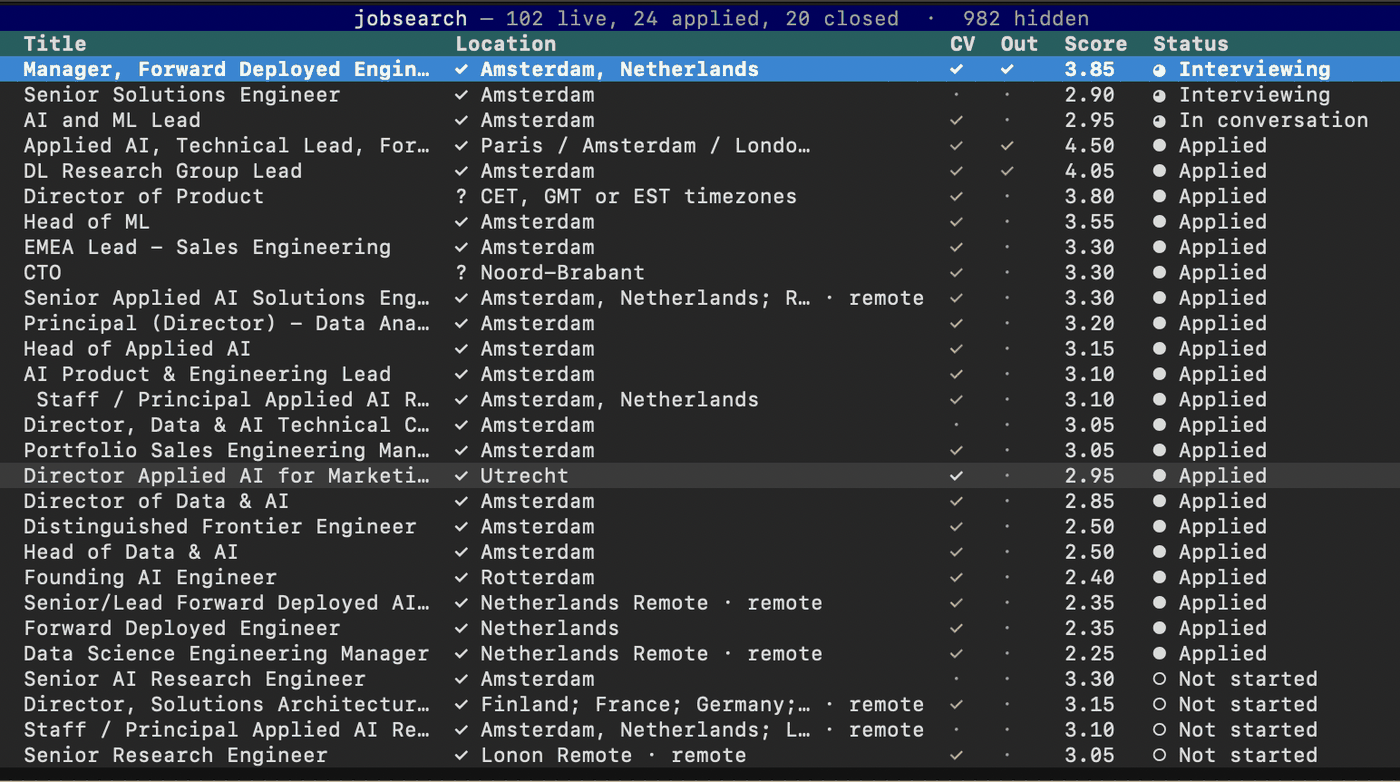
A terminal app for running a senior job search: finds roles on public job-board APIs, scores them against a strategy written in prose, tailors a CV from a fact base without inventing anything, and proves the PDF survives an ATS parser. Three of the first four CVs it checked failed, each for a different reason, none visible by looking at the PDF.
Typed, calibrated decisions from small local models, behind the same interface as a hosted decision model: state in, a probability-weighted choice out, no text generation. Includes a routing benchmark and a distilled encoder that answers in 19 milliseconds on a laptop.
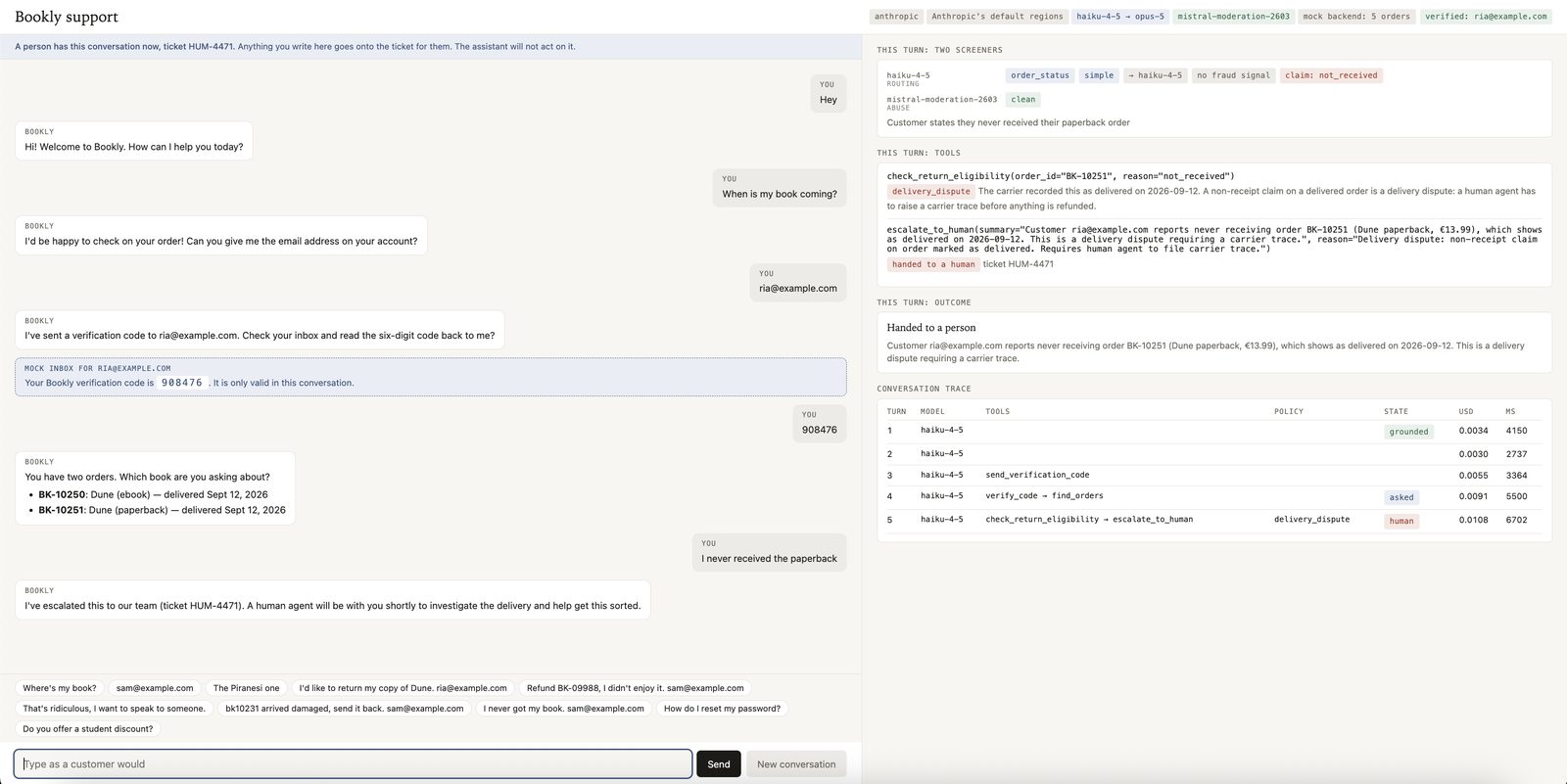
A customer support agent for a fictional bookstore, built for a solutions-engineering take-home. The model understands the customer and code decides: policy as code, the clarifying question as a gate, hand-over by rule rather than by the model's mood, and model routing priced from measured tokens.
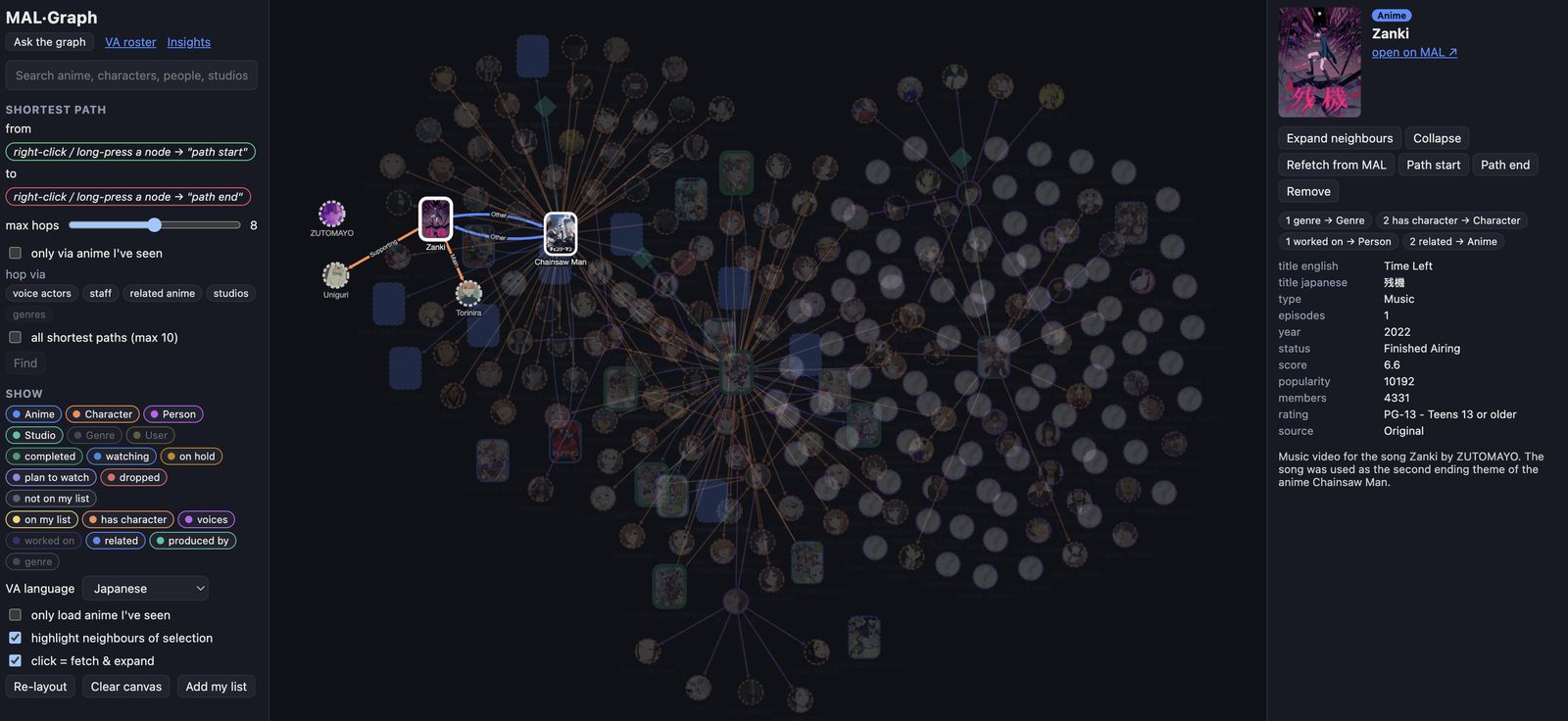
My anime list as an explorable graph: titles, characters, voice actors, staff and studios in Memgraph, explored through a React and Cytoscape interface. The fun one, and a small excuse to keep the graph-database muscles working.
A usability benchmark for agent-facing APIs. An MCP server is a user interface whose user is a language model, and this runs a fixed suite of tasks through an agent with cold context, then scores which tool it reached for, whether the call validated, and what it cost to recover. Ships pointed at an image-generation API because slow, job-shaped, expensive calls are where ergonomics matter.
Raw Power Labs is the applied AI lab of Archon Group, based in Copenhagen. It builds generative AI tools for game studios and enterprises, from data preparation and company-owned small language models to a knowledge graph for game narrative, a generative asset vault and an on-device model runtime. It grew from 6 to 28 people while I was there.
Took the on-device small language model platform from zero to product-market fit with paying customers in two years; originated it and built its evaluation stack.
Authored the product-line strategy, portfolio revenue model and enterprise pricing architecture used in an active investment process. Redesigned pricing from per-model metering to flat platform fees gated by production use cases.
Landed a technology partnership with a global semiconductor leader, re-engaging a stalled relationship through to approved co-marketing.
Built the academic pipeline: a published university collaboration on small-language-model content generation and a funded industry-track PhD proposal.
2022 to 2024
Director of Data Science (Forward Deployed Engineering)
Abacus.AI, Amsterdam
Abacus.AI is a San Francisco AI platform company whose tools let enterprises build, deploy and run machine learning models, generative AI applications and agents.
One of two worldwide leads building the Customer Success Data Science team, and the banking specialist: landed the company's first bank customer and owned every bank after it.
Shipped customer-facing generative AI on the platform: custom chat LLMs and agents across several industries. Cut a prospect's sales forecasting error by half, a measured six million dollars in labour cost.
2020 to 2022
Senior Data Scientist, Customer Facing Data Scientist
DataRobot, Johannesburg and Amsterdam
DataRobot is a Boston enterprise AI platform company, best known for automated machine learning and MLOps.
Foundational lead of a three-person Middle East and Africa presales team; worked with more than three dozen organisations. EMEA subject matter expert on MLOps, monitoring and governance.
Built, deployed and integrated a churn model into a state-owned bank's Oracle estate in three days, against a prior six-month manual effort. Helped a bank rebuild its real-time fraud model: half the false negatives at the same alert volume.
2015 to 2020
Quantitative Analyst, then Senior Quantitative Analyst
First National Bank, Johannesburg
First National Bank is one of South Africa's four largest retail and commercial banks, and part of the FirstRand group.
Credit origination and collections scorecards, fraud, forecasting, A/B testing, and model-monitoring frameworks built from first principles.
Built the bank's first bespoke subsidiary scorecard, cutting the default rate by 150 basis points in its first year, and pipelines processing 15 terabytes of transactional data a day.
Talks and papers
Selected work
PatentInventor, A Method for Creating Specialized Language Models, application PA/2025/30389, approved for PCT international filing (2026). Not yet published.
PodcastSmå sprogmodeller til spil og meget mere. AI Denmark podcast, February 2025, with Annemette Kiil Mørup. Fifty minutes on small, task-specific language models for games, in Danish and English.
TalkThe Raw Power case. AI Denmark Summit 2024, Dansk Industri, Copenhagen, December 2024, with Annemette Kiil Mørup.
PythonRustTypeScriptSQLagentic architecturesevaluation pipelineson-device and small language modelsknowledge graphsobservability and model monitoringMLOpsoperations research
Contact
Get in touch
Based in Amsterdam and authorised to work in the Netherlands. Email is the reliable channel.